


J.League Schedule and Fixtures
The 2026/27 J.League season introduces the competition's new August-to-June calendar. J1 begins on August 7, 2026, with the league's final fixtures scheduled for June 6, 2027. J2 and J3 begin in August and finish on May 23, 2027. Each division features 20 clubs playing 38 matchdays in a home-and-away format. The opening J1 fixture is Yokohama F. Marinos vs Kashima Antlers on Friday, August 7, at 19:30.
The 2026 schedule covers J1 Matchweeks 1 to 20 and J2 and J3 Matchweeks 1 to 22 with confirmed dates, kickoff times, venues, and broadcast information. Details for 2027 fixtures are scheduled for release in early December. The J.League fixture schedule helps fans follow each club's upcoming matches, home and away games, matchweek position, kickoff times, and venues. The official fixture page also provides current results and scheduling updates, making it useful for tracking the season as fixtures are played or adjusted.
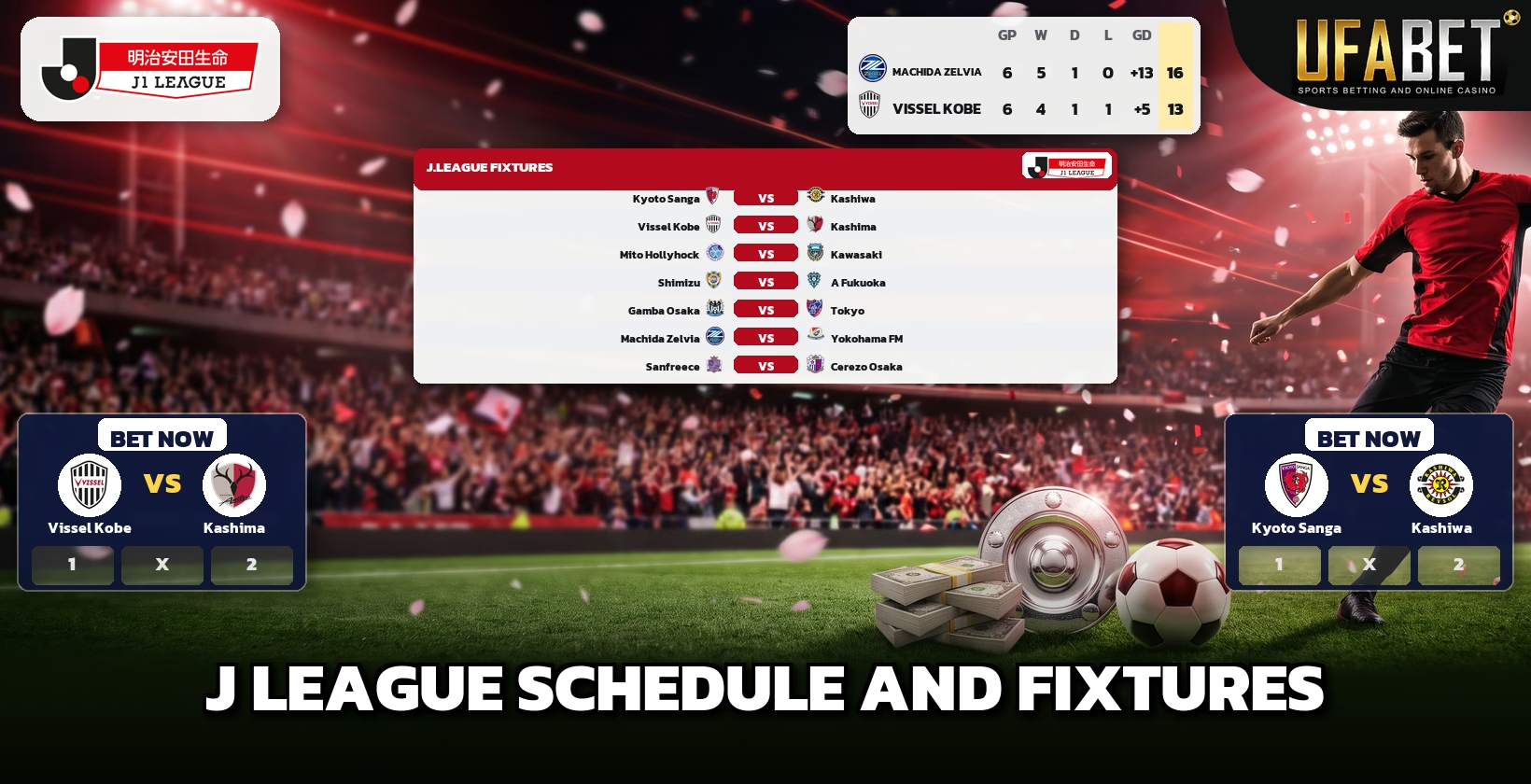
J.League Schedule and Fixtures 2026/2027 Season
 By Month

| 16:30 |  FC Tokyo Kawasaki Frontale | Not Started |  |
| 13:00 | V-Varen Nagasaki Shimizu S-Pulse | Not Started | |
| 12:00 | Verdy Kyoto | Not Started | |
| 13:00 | Cerezo Osaka Mito | Not Started | |
| 11:00 | Chiba Kashima Antlers | Not Started | |
| 13:00 | Gamba Osaka Yokohama F. Marinos | Not Started | |
| 14:00 | Kashiwa Reysol Avispa Fukuoka | Not Started | |
| 14:00 | Machida Okayama | Not Started | |
| 12:00 | Sanfrecce Hiroshima Vissel Kobe | Not Started | |
| 12:00 | Urawa Reds Nagoya Grampus | Not Started | |
How to Bet on J.League Games on UFABET?
What J.League Matches Can You Bet on UFABET?
J.League matches that you can bet on at UFABET are listed below.
- J1 League Matches: Wagers cover selected fixtures involving J1 clubs.
- Upcoming Matches: Markets appear for scheduled games before kickoff.
- Selected Fixtures: Match availability depends on the sportsbook schedule.
- High-Profile Matches: Major J1 fixtures often receive a wider range of betting markets.
How Do J.League Betting Odds Work on UFABET?
Users select a market and review the displayed odds before adding a selection to the bet slip. The final payout depends on the stake and combined odds for selected wagers. Pre-match odds apply before kickoff, while live betting odds change during matches as goals, cards, substitutions, and other events affect market prices.
What Types of J.League Bets Can You Place on UFABET?
Types of J. League bets that you can place on UFABET are listed below.
- Match Result: Predict the home win, draw, or away win.
- Over or Under Goals: Predict whether total goals finish above or below a listed line.
- Both Teams to Score: Predict whether both teams score during the match.
- Other Markets: Additional selections depend on the fixture and available sportsbook markets.
What Are the Most Anticipated J.League Games This Season?
Which J.League Matches Are the Biggest Rivalries?
Derby matches carry additional significance because local pride sits alongside league points. The Ibaraki Derby received particular attention during the 2026 season after Mito Hollyhock defeated Kashima Antlers 4-2 on penalties following a 1-1 draw in the first J.League meeting between the clubs.
When Is the Next Major J.League Rivalry Scheduled?
The 2026/27 calendar features several regional and metropolitan matchups throughout the campaign. Derby dates should be checked against the latest official fixture list because kickoff times and venues are subject to schedule revisions.
Which Other J.League Derbies Are Worth Watching?
The Ibaraki Derby between Kashima Antlers and Mito Hollyhock offers another notable regional matchup. The 2026 meeting received significant coverage after Mito won the first J.League Ibaraki Derby on penalties. The Saitama Derby involving Urawa Reds holds strong regional importance when both clubs share the same division.
What Factors Make a J.League Fixture Highly Anticipated?
Factors that make a J.League fixture highly anticipated are listed below.
- Local Rivalry: Nearby clubs compete for regional pride and supporter attention.
- League Position: Matches involving clubs near the top or bottom of the table carry stronger consequences.
- Recent Form: Winning or unbeaten runs add competitive interest before kickoff.
- Club Reputation: Established J1 clubs often attract greater attention.
- Qualification Pressure: AFC competition places and other league objectives raise the stakes.
- Venue Atmosphere: Large stadiums and strong supporter traditions contribute to match appeal.
When Does the 2026/2027 J.League Season Start and End?
The new calendar places league football across autumn, winter, and spring before the final matchday in June.
The schedule includes a winter period without regular J1 league fixtures. Match dates throughout the season remain subject to official scheduling updates, including
changes linked to competition commitments and other calendar requirements. The revised calendar aligns the domestic season more closely with the AFC competition schedule.
How Many Matches Are Included in the J.League Schedule?
Each matchday normally contains 10 fixtures because 20 clubs are paired into 10 games. The full schedule therefore distributes 10 matches across each of the 38 matchdays. Fixture dates vary across Friday, Saturday, Sunday, and selected weekdays based on scheduling requirements. Domestic cup matches, AFC competitions, stadium availability, broadcasting arrangements, and other calendar factors influence individual fixture dates. Postponed matches receive revised dates while remaining part of the 380-match league programme.
When Is the J.League Fixture List Released?
The 2026/27 season required additional scheduling work because J.League moved to an August-to-June calendar. The J1 campaign runs from August 7, 2026, through June 6, 2027, across 38 matchdays. Match dates receive updates during the campaign when competition requirements affect the original schedule. Domestic cups, AFC competitions, stadium availability, and broadcasting arrangements influence later fixture adjustments. The official J.League schedule reflects confirmed changes as the season progresses.
Where Can You Find the Latest J.League Fixtures?
The fixture pages help track individual clubs and specific matchweeks throughout the season. Users can review opponents, venues, dates, kickoff times, and completed results from the published schedule. The official listing reflects confirmed postponements, rescheduled fixtures, and venue changes. Checking the schedule before matchday provides current information for planning around J.League fixtures.
How Many Matchdays Are Played in a J.League Season?
How Does the J.League Schedule Work?
Match dates are distributed across weekends and selected weekdays, while venue availability, cup competitions, AFC commitments, and other scheduling requirements influence individual fixtures. The schedule accounts for international calendar periods and other competition dates. League officials adjust selected fixtures when scheduling conflicts arise, while maintaining the required home-and-away structure.
How Is the J.League Fixture Schedule Created?
The 2026/27 J1 League season contains 20 clubs and 380 matches across 38 matchdays. Every club faces each opponent twice, with one home fixture and one away fixture. Stadium operations, travel distances, broadcasting requirements, and competition commitments influence fixture placement. Schedule revisions follow when confirmed requirements affect previously announced fixtures.
What Factors Are Considered When Scheduling J.League Matches?
Factors that are considered when scheduling J. League matches are listed below.
- Stadium Availability: Clubs require suitable home venues for scheduled fixtures.
- Travel Requirements: Fixture placement considers travel between Japanese regions.
- Cup Competitions: Levain Cup matches require space within the football calendar.
- AFC Competitions: Clubs competing in continental tournaments require compatible schedules.
- Broadcasting: Television and streaming arrangements influence selected kickoff times.
- Weather Conditions: Seasonal conditions affect fixture planning and venue considerations.
- International Calendar: National-team commitments influence available dates.
- League Balance: The schedule maintains the required home-and-away structure.
How Are J.League Matches Distributed Across the Weekend?
Matchweek 7 includes starts from 18:00 through 19:00 Japan Standard Time. The staggered schedule provides flexibility for stadium operations, broadcasting, travel, and supporter attendance. Fixture placement helps clubs manage congestion when domestic cup matches or AFC competitions occupy nearby dates. Weekend scheduling gives supporters several opportunities to follow J.League action across the full matchweek.
Why Are Some J.League Matches Played on Weekdays?
Midweek fixtures help manage a crowded football calendar throughout the season. Clubs competing in domestic cups or AFC tournaments require suitable dates between league matches. Stadium availability and broadcasting arrangements influence fixture placement. The J.League schedule therefore spreads selected matches across weekdays and weekends while maintaining the required league structure. Official fixture updates provide the latest confirmed dates and kickoff times when scheduling changes occur.
How Are Home and Away Fixtures Balanced Throughout the Season?
The fixture sequence avoids concentrating home or away games into one extended period. Clubs move between home and away venues throughout the campaign according to the published schedule. Domestic cup competitions, AFC commitments, stadium availability, and other scheduling factors influence fixture placement. Each club still finishes the league season with an equal split of 19 home matches and 19 away matches.
What J.League Games Are Scheduled This Week?
J. League games that are scheduled this week are shown in the table below.
Which J.League Teams Are Playing This Weekend?
The weekend schedule covers all 20 J1 clubs, with each team playing one league fixture during Matchweek 7. Friday provides two opening fixtures, while Saturday carries six matches and Sunday completes the round with two matches. Kickoff times range from 18:00 to 19:00 JST across the three days. Each fixture includes a designated home venue and away opponent. The schedule provides a complete view of the weekend's J1 League action and helps track upcoming fixtures across Matchweek 7.
What Are the Next J.League Fixtures?
The September 9 cup fixtures provide midweek action before J1 League Matchweek 7 begins. Three Levain Cup matches start at 19:00 JST, while Reilac Shiga FC vs Tokyo Verdy starts at 18:30 JST. Friday's J1 fixtures open the weekend schedule before six matches take place on Saturday. Two further J1 fixtures complete Matchweek 7 on Sunday. Fixture dates and kickoff times reflect the current official schedule. Checking the latest J.League listing provides updated information if any match receives a scheduling change.
Which J.League Matches Are Scheduled for Today?
The gap between J1 League matchweeks reflects the wider domestic competition calendar. Levain Cup fixtures provide competitive action during the midweek period before J1 Matchweek 7 begins on Friday, September 11. The next J1 round features 10 fixtures across Friday, Saturday, and Sunday. Checking the official J.League fixture schedule provides the latest match dates, competition details, venues, and kickoff times. Schedule information should be reviewed before planning around a specific fixture.
What Time Do This Week's J.League Matches Start?
The weekly schedule spreads fixtures across Wednesday, Friday, Saturday, and Sunday. Cup matches provide midweek action before the J1 League weekend round begins. Saturday features the largest group of J1 fixtures, with six matches scheduled across three kickoff times. Sunday completes Matchweek 7 with two fixtures. Kickoff times reflect stadium operations, broadcasting arrangements, travel requirements, and competition scheduling. Official J.League fixture information provides the latest confirmed times when schedule changes occur.
Which J.League Matches Are Being Played Tomorrow?
The four fixtures involve clubs from different levels of Japanese football, creating a varied cup schedule alongside the J1 League calendar. Three matches begin at 19:00 JST, while Reilac Shiga FC and Tokyo Verdy have the earliest kickoff at 18:30 JST. The Levain Cup provides additional competitive fixtures during the domestic season. Match dates and kickoff times remain subject to official schedule updates. Checking the latest J.League fixture information provides the current details before each match.
What Time Do J.League Matches Usually Kick Off?
Kickoff times vary according to broadcasting arrangements, stadium operations, supporter travel, and the wider competition calendar. Evening starts provide a consistent pattern for many J1 fixtures, particularly during weekend matchweeks. Selected fixtures receive earlier or later times based on scheduling needs. Domestic cup matches and AFC commitments influence fixture placement. The official J.League schedule provides the confirmed date, venue, and kickoff time for each match. Checking the latest fixture listing helps identify any updates before matchday.
Why Do J.League Matches Have Different Kickoff Times?
The current Matchweek 7 schedule illustrates the variation. Mito Hollyhock vs Kawasaki Frontale starts at 18:00 JST, Shimizu S-Pulse vs Avispa Fukuoka starts at 18:30, and several Saturday matches start at 19:00. Sunday uses 18:00 and 18:30 starts.
How Are Saturday J.League Fixtures Scheduled?
Saturday scheduling gives the J.League its main concentration of weekend fixtures. Multiple kickoff windows help distribute matches across television coverage, stadium operations, supporter travel, and matchday planning. Fixture times depend on the wider competition calendar and venue availability. Domestic cup matches and AFC commitments influence selected dates when clubs face additional fixtures. The official J.League schedule provides the latest confirmed Saturday match dates, venues, opponents, and kickoff times for each fixture.
How Are Sunday J. League Fixtures Scheduled?
Sunday scheduling spreads the matchweek across multiple days and provides additional viewing opportunities for supporters. Different kickoff times help manage broadcasting plans, stadium operations, and travel requirements. Fixture placement varies between matchweeks based on the wider competition calendar. The official J.League schedule lists confirmed Sunday opponents, venues, dates, and kickoff times. Schedule updates reflect postponed fixtures and other confirmed changes.
When Are Friday J.League Matches Played?
Friday scheduling creates an earlier start to the weekend round while leaving the remaining fixtures across Saturday and Sunday. Selected Friday fixtures help distribute matches across the matchweek and manage stadium availability. Kickoff times remain subject to confirmed schedule updates. The official J.League fixture list provides the latest dates, venues, opponents, and kickoff times for Friday matches.
Are J.League Matches Played on Mondays?
Cup competitions follow separate scheduling patterns and introduce additional match dates during the season. Domestic cup commitments, AFC competitions, stadium availability, broadcasting arrangements, and international windows influence fixture placement. The 2026/27 J1 League season covers 38 matchdays between August 7, 2026, and June 6, 2027. Match dates therefore vary across the calendar to accommodate wider football commitments. Checking the official J.League schedule provides the latest confirmed date and kickoff time for each fixture.
Can J.League Kickoff Times Change After the Fixtures Are Released?
The J.League publishes revised fixture information when confirmed changes occur. Clubs receive updated match details when dates or kickoff times are adjusted. The official fixtures page remains the primary reference for current J1 League dates, opponents, venues, and kickoff times. Checking the latest schedule before a match provides the most accurate information. Fixture updates help supporters identify changes before making travel or ticket arrangements.
J.League Fixtures by Team
J.League fixtures by team are shown in the table below.
How Can You Find an Individual Team's J.League Schedule?
Team schedules show fixture changes when matches are postponed or rescheduled. Check the latest fixture information before planning attendance because dates and kickoff times can change during the season.
How Can You Check a Team's Next J.League Match?
Club websites publish upcoming fixtures with ticket and matchday information. Check the latest listing before traveling because fixture times and venues sometimes change. Postponed matches receive revised dates after rescheduling. The latest fixture listing reflects confirmed venue changes and updated kickoff times. Reviewing official sources provides current information when planning attendance around the next J.League match.
How Can You Find a Team's Complete J.League Fixture List?
A complete fixture list provides the scheduled date, opponent, venue, kickoff time, and match status for each game. Reviewing the full schedule helps track upcoming matches, completed results, and the sequence of home and away fixtures. Updated schedules reflect postponed matches and confirmed rescheduled dates. Venue changes and revised kickoff times appear in the latest fixture information. The complete listing provides a convenient reference for following one club throughout the J.League season.
How Can You Check a Team's Home and Away Fixtures?
Filtering fixtures by team provides a complete view of both categories. The schedule helps identify consecutive home games, away trips, and changes to originally scheduled venues. Each fixture includes the opponent, match date, kickoff time, and competition status. Reviewing venue details helps distinguish home matches from away matches when fixtures occur across different stadiums. Updated listings reflect confirmed venue changes or revised match dates.
How Does a J.League Matchday Work?
J.League fixtures do not always take place on one day. Matches within a matchday often spread across different dates and kickoff times based on television arrangements, stadium availability, cup commitments, and other scheduling factors. Each fixture receives its own date, venue, and kickoff time within the matchday. Completed games display final scores, while upcoming fixtures show scheduled details. Postponed games receive revised dates after rescheduling. The official J.League fixture list provides the latest matchday information and helps track completed and upcoming fixtures throughout the season.
How Many Matches Are Played During Each J.League Matchday?
Each club plays one fixture during a standard matchday. The schedule distributes matches across different dates and kickoff times based on stadium availability and competition requirements. Postponements or schedule adjustments sometimes leave fewer matches completed within the original matchday period. Rescheduled fixtures are played later and recorded once completed. The official fixture list reflects the revised dates and results after each postponed match is completed.
How Are J.League Fixtures Organized by Matchday?
The official schedule lists matches by competition and date. Matchday numbers help supporters follow the league sequence and compare results across different stages of the season. Each fixture receives a specific date and venue within the matchday schedule. Completed fixtures display final results, while upcoming fixtures show confirmed scheduling details. Postponed matches receive updated dates after rescheduling, with the official schedule reflecting the latest fixture information.
How Can You Find the Fixtures for a Specific J.League Matchday?
The fixture page shows match results after games are completed. Checking the official listing provides updated information when postponements or rescheduling affect the original matchday. Fixture details reflect confirmed changes to dates, venues, and kickoff times. Each listed match identifies the two participating clubs and the designated home venue. Matchday information helps track upcoming games within the 2026/27 J1 League season. Reviewing the latest listing provides accurate fixture information before planning around a specific matchday.
What Is the Difference Between a J.League Matchday and a Fixture?
Each fixture has its own opponent, venue, date, and kickoff time. Matchday numbering groups individual fixtures within the broader league schedule and helps organize the season. A matchday shows how clubs progress through the campaign, while a fixture identifies the exact contest between two teams. Postponements or schedule changes affect individual fixtures without necessarily changing the matchday numbering.
How Can You Check Completed and Upcoming Matchdays?